
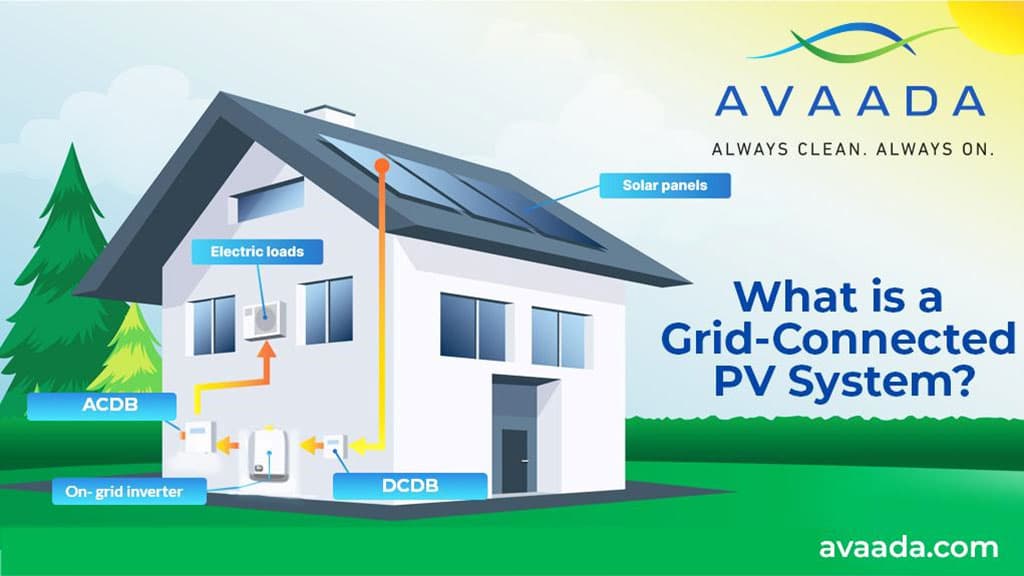
A grid-connected PV (photovoltaic) system is a solar power setup in which solar panels or arrays are directly connected to the local utility electrical grid via an inverter. This arrangement enables the system to supply electricity to the grid when excess solar power is generated and draw electricity from the grid when solar output is insufficient, such as at night or during cloudy weather. It is also called a “grid-tied” or “on-grid” solar system. It is popular for residential, commercial, and industrial applications because it provides continuous power without batteries.
Key Components of a Grid-Connected Solar PV System
A grid-connected solar PV system consists of the following main components:
- Solar PV Modules: These panels convert sunlight into direct current (DC) electricity. Their capacity and efficiency affect overall system performance. Leading solar PV module manufacturers focus on high wattage and efficiency, such as the 610Wp, 630Wp and 720Wp modules produced by Avaada using n-type TopCon technology, which is prominent in India.
- Inverter: The inverter converts DC electricity from solar panels into alternating current (AC) suitable for home use or for grid connection. The inverter also synchronizes the phase and voltage with the grid to enable smooth energy export and import.
- Bi-directional Meter/Net Meter: It monitors electricity flow in both directions, enabling measurement of power consumed from the grid and of surplus solar power fed back to the grid. This facilitates net metering benefits, effectively reducing electricity bills.
- Protection Devices: These include circuit breakers, isolators, and surge protection to safeguard the system against faults and ensure safety during grid outages.
- Monitoring System: Provides real-time performance data to detect issues early and optimize system operation.
How Does a Grid-Connected PV System Work?
During sunlight hours, solar PV modules generate DC electricity. The inverter converts this power to AC and supplies it primarily for on-site consumption. If solar generation exceeds onsite electricity demand, the excess power is exported to the grid and credited to the customer’s account through net metering. During nighttime or periods of low solar generation, electricity is drawn from the utility grid to meet demand, ensuring an uninterrupted power supply.
Advantages of a Grid-Connected Solar PV System
Grid-connected solar PV systems provide an efficient and practical way to harness solar energy by integrating seamlessly with the existing electricity grid, offering numerous economic and environmental benefits.
- Cost-effective: No need for expensive battery storage reduces upfront investment and maintenance costs.
- Energy Savings: Users reduce electricity bills by using solar power and earning credits for exported surplus.
- Environmentally Friendly: Supports renewable energy adoption and lowers carbon footprint by reducing reliance on fossil fuels.
- Reliable Supply: Seamless power availability with grid backup during low solar production.
- Scalability: Systems can be sized based on load requirements and future expansion.
Overall, grid-connected solar PV systems deliver a cost-effective, reliable, and scalable energy solution that supports sustainable development and a cleaner future while optimizing energy use and minimizing environmental impact.
The Role of Solar PV Module Manufacturers
The quality and performance of solar PV modules are critical for the efficiency and durability of grid-connected solar PV systems. Avaada has made a significant impact on India’s solar industry by producing high-wattage modules (610Wp, 630 Wp & 720Wp) using integrated manufacturing processes for cells, wafers, glass, and frames at a single facility. Avaada’s modules carry major certifications (IEC, BIS, UL, TUV), ensuring conformity with global standards. Their focus on proven n-type TopCon technology supports system reliability and performance, essential for large-scale grid-connected solar deployments, especially in rapidly growing states like Uttar Pradesh, Gujarat, Maharashtra, Rajasthan, Andhra Pradesh, Telangana, Madhya Pradesh, and Tamil Nadu.
Applications of Grid-Connected PV Systems
Grid-connected photovoltaic (PV) systems have versatile applications across residential, commercial, utility, and industrial sectors, enabling sustainable and cost-effective clean energy generation.
- Residential rooftops supply clean energy and lower household electricity costs.
- Commercial buildings are reducing operational energy expenses.
- Utility-scale solar farms feed large amounts of renewable power into the grid to meet regional demand.
- Industrial facilities integrating renewable energy to comply with sustainability mandates and lower energy costs.
These diverse applications demonstrate that grid-connected systems are integral to advancing renewable energy adoption and supporting energy sustainability at various scales and across industries.
Latest Trends and Market Context in India
India added approximately 26.6 GW of solar capacity in the first nine months of 2025, a 53.7% increase compared to the same period last year. Large-scale grid-connected solar projects dominate these additions. Market demand for higher-wattage, efficient solar modules is accelerating, with manufacturers expanding production capacities and diversifying their technology portfolios. Government regulations, such as the Approved List of Modules and Manufacturers (ALMM), set quality benchmarks, driving the adoption of reliable grid-connected solar PV systems.
Avaada Group is one of the key players in India’s solar manufacturing sector, is expanding its footprint with a manufacturing capacity of 6 GW and modules exceeding 700 Wp capacity. Its vertically integrated manufacturing setup enables control over quality and supply chain, making it instrumental in supporting India’s growing grid-connected solar system market. Avaada’s installations in Maharashtra, Rajasthan, and Gujarat highlight the successful deployment of high-capacity grid-connected solar PV systems that help meet the energy demand of these high-growth states without requiring storage.
Conclusion
A grid-connected PV system is a clean energy solution that reduces reliance on conventional power while providing reliable electricity by interfacing with the utility grid. With Avaada advancing Solar PV manufacturing in India through high-wattage modules and integrated production, grid-connected solar systems are poised to grow across multiple states. This technology not only fosters energy sustainability but also accelerates India’s transition towards renewable energy.
FAQs
What is a grid-connected PV system, and how does it work?
A grid-connected PV system is a solar power system linked directly to the utility grid. It generates electricity from solar panels, supplies power to onsite loads, exports excess energy to the grid, and draws electricity from the grid when solar generation is low.
What is the difference between grid-connected and off-grid solar systems?
A grid-connected PV system operates without batteries and relies on the utility grid for backup power. In contrast, an off-grid PV system uses batteries for energy storage and operates independently of the grid.
Do grid-connected PV systems work during power cuts?
No. For safety reasons, grid-connected PV systems automatically shut down during grid outages unless paired with additional backup systems such as hybrid inverters or energy storage.
What are the main components of a grid-connected solar PV system?
The key components include solar PV modules, an inverter, a Bi-directional or net meter, protection devices, and a monitoring system to track performance and safety.
What is net metering in a grid-connected solar system?
Net metering is a billing mechanism that records electricity exported to and imported from the grid, allowing consumers to receive credits for surplus solar power fed back into the utility network.
Is a grid-connected PV system suitable for residential use in India?
Yes. Grid-connected PV systems are widely used on residential rooftops in India because they reduce electricity bills, require no battery storage, and comply with state net-metering regulations.
What are the advantages of a grid-connected solar PV system?
Grid-connected PV systems offer lower upfront costs, energy bill savings, reliable grid backup, environmental benefits, and easy scalability without the need for batteries.
How much electricity can a grid-connected solar system generate?
Electricity generation depends on module capacity, system size, solar irradiance, and efficiency. High-wattage modules help maximize output for residential, commercial, and utility-scale installations.
Are grid-connected PV systems allowed under Indian government regulations?
Yes. Grid-connected solar systems are supported under Indian renewable energy policies and must comply with regulations such as ALMM and state electricity board net-metering guidelines.
Where are grid-connected PV systems commonly used?
They are widely deployed on residential rooftops, commercial buildings, industrial facilities, and utility-scale solar farms to meet clean energy demands.
Why are high-wattage solar modules important for grid-connected systems?
High-wattage modules improve energy generation efficiency, reduce balance-of-system costs, and are ideal for large-scale grid-connected solar installations.
Is battery storage required for a grid-connected PV system?
No. Grid-connected PV systems operate without batteries, using the utility grid as backup during nighttime or low-solar-production periods.